Connecting Canada
Prioritizing Indigenous involvement in emerging technology
Nov 24, 2025
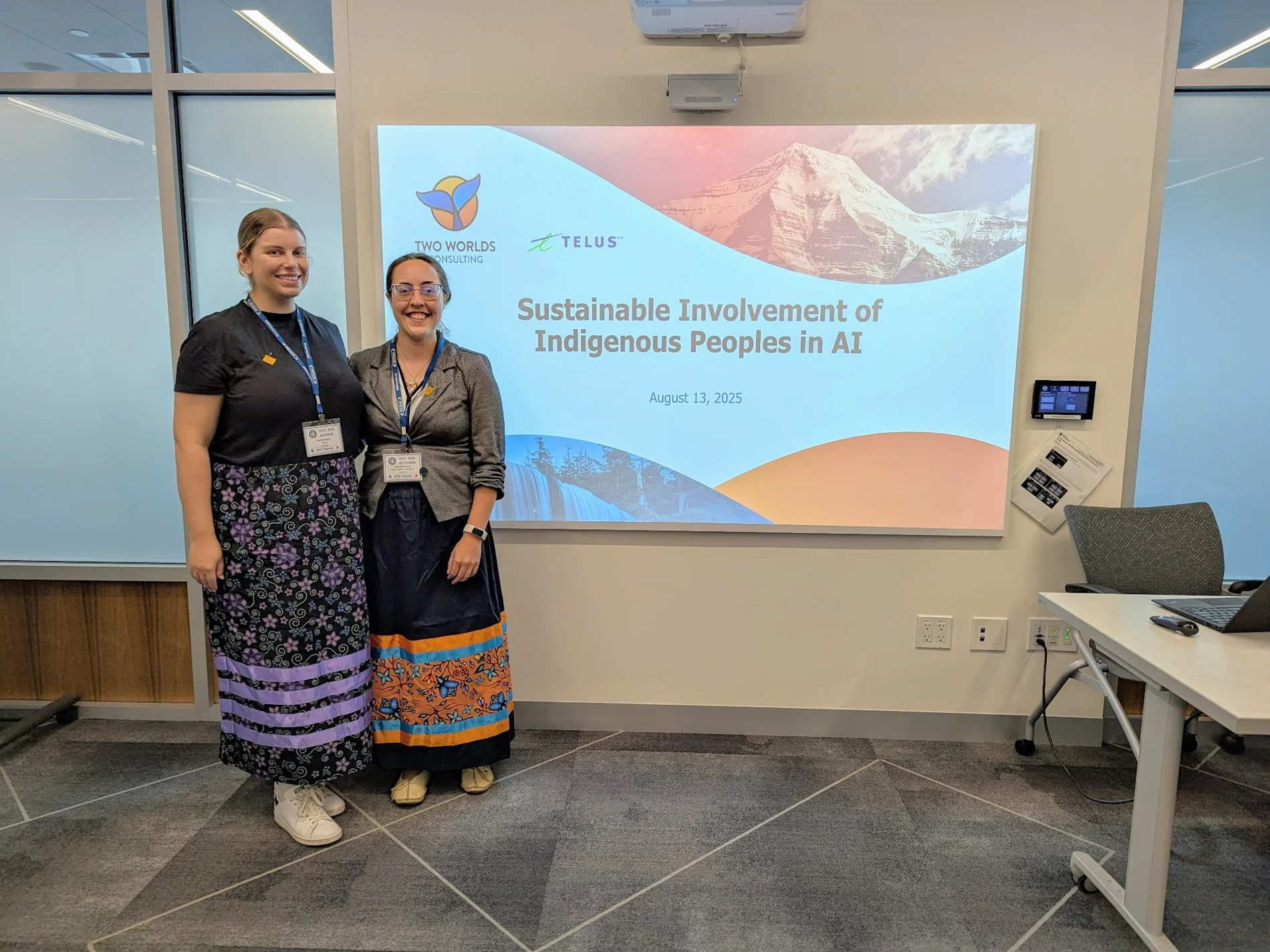
When Kendal Burtch, TELUS team member, and Melanie Demers of
Two Worlds Consulting
, presented to fellow researchers at the 2025 Institute of Electrical and Electronics Engineers (IEEE) International Humanitarian Technology Conference
, they spoke about how to improve artificial intelligence (AI) systems. But they weren't talking about optimizing algorithms. They were talking about ways to build respect and sovereignty into AI’s design, and involving voices and perspectives that will help shape the technology that will define our future."We can build the most sophisticated AI systems in the world," Burtch says, "but if they're built without Indigenous perspectives, without understanding Indigenous data sovereignty, without meaningful partnership - they’ll always fall short.”
While Western AI development tends to approach data as individual, quantifiable points of information, Indigenous perspectives on data are relational, holistic, and inseparable from community, land, and generations of Indigenous Knowledge. The challenge is that most AI systems today operate on Western frameworks, and are often based on data that misrepresents Indigenous Peoples, which means these systems may miss the full context and meaning of Indigenous data and Knowledge.
The path forward? Prioritizing Indigenous participation in emerging technology. When we do, AI becomes better for everyone.
As AI rapidly advances, we have an opportunity to build these powerful tools thoughtfully and sustainably, with meaningful involvement from Indigenous Peoples right from the start.
Involving Indigenous Peoples across Canada - First Nations, Inuit, and Métis communities - in AI development benefits everyone. By embedding Indigenous Knowledge, values, and data sovereignty principles into the foundation of emerging technologies, we can create systems that are more ethical, fair, and effective for all.
Research that matters
Earlier this year, Burtch and Demers co-authored and presented research at the 2025 IEEE International Humanitarian Technology Conference on a topic central to TELUS’ commitment to social good: Indigenous involvement in emerging technologies. The paper, “
Sustainable Involvement of Indigenous Peoples in AI
,” has significant implications not just for TELUS, but for anyone building technology in the 21st century.TELUS, in partnership with Indigenous communities and Indigenous businesses, has embarked on a journey to understand what meaningful Indigenous involvement in AI looks like in practice. Two Worlds Consulting led workshops on behalf of TELUS with First Nations, Inuit, and Métis Peoples across Canada to explore critical questions about data ethics, AI development, and Indigenous Knowledge.
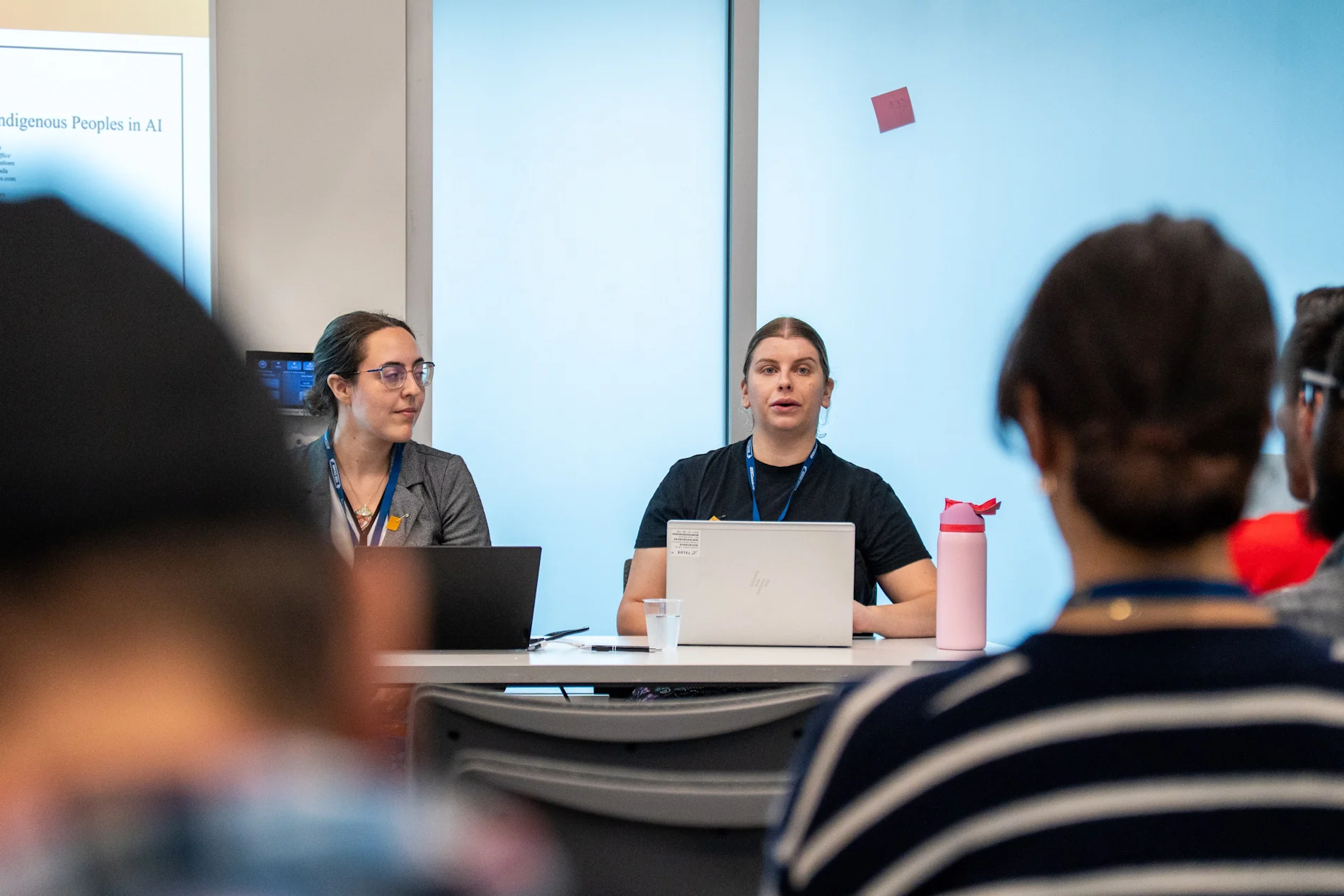
Melanie Demers of Two Worlds Consulting (left) and Kendal Burtch from TELUS (right) share insights on prioritizing Indigenous involvement in AI.
Why meaningful dialogue matters
Indigenous Peoples have often been excluded from the development of technology, leading to systems that do not reflect their voices, values, or Knowledge. When Indigenous Peoples are not meaningfully involved, we risk perpetuating that historical exclusion, creating AI systems that deepen existing inequalities and fail to reflect Indigenous Knowledge systems.
Thirty-five per cent of Indigenous respondents in
TELUS' 2024 AI Report
said they feel that AI is biased against them. This bias can take many forms, from facial recognition with higher error rates for Indigenous faces, to language models that fail to recognize Indigenous languages and names, to AI-generated content that perpetuates racist beliefs or misrepresents Indigenous cultures. As Canada invests in AI development, we have a choice: will this technology deepen existing inequalities, or will it help close them?Understanding Indigenous data and AI
AI is only as representative as the data that it is trained on. When AI systems are trained on data that doesn't respect Indigenous perspectives - or worse, when Indigenous data is used without consent or understanding - the results can perpetuate harm, bias, and appropriation.
Western understandings of data often refer to pieces of individual information - ones and zeroes that represent singular points of data that can be isolated, processed, and analyzed independently. Indigenous perspectives on data are different. Indigenous data encompasses everything connected to Indigenous Peoples, including their lands, languages, resources, cultural practices, and Traditional Knowledge. This data is holistic and interconnected, inseparable from community identity and sovereignty.
Without understanding these forms of Indigenous Knowledge, we risk losing context or meaning through processing in an AI model.
For example, when AI processes traditional food preparation as simply a recipe - a list of ingredients and steps - it loses something essential. Traditional food preparation is Indigenous data that encompasses stories, history, connections to land and seasons, Knowledge passed down through generations, and community relationships. The holistic, interconnected nature of this knowledge cannot be captured by isolating individual data points.
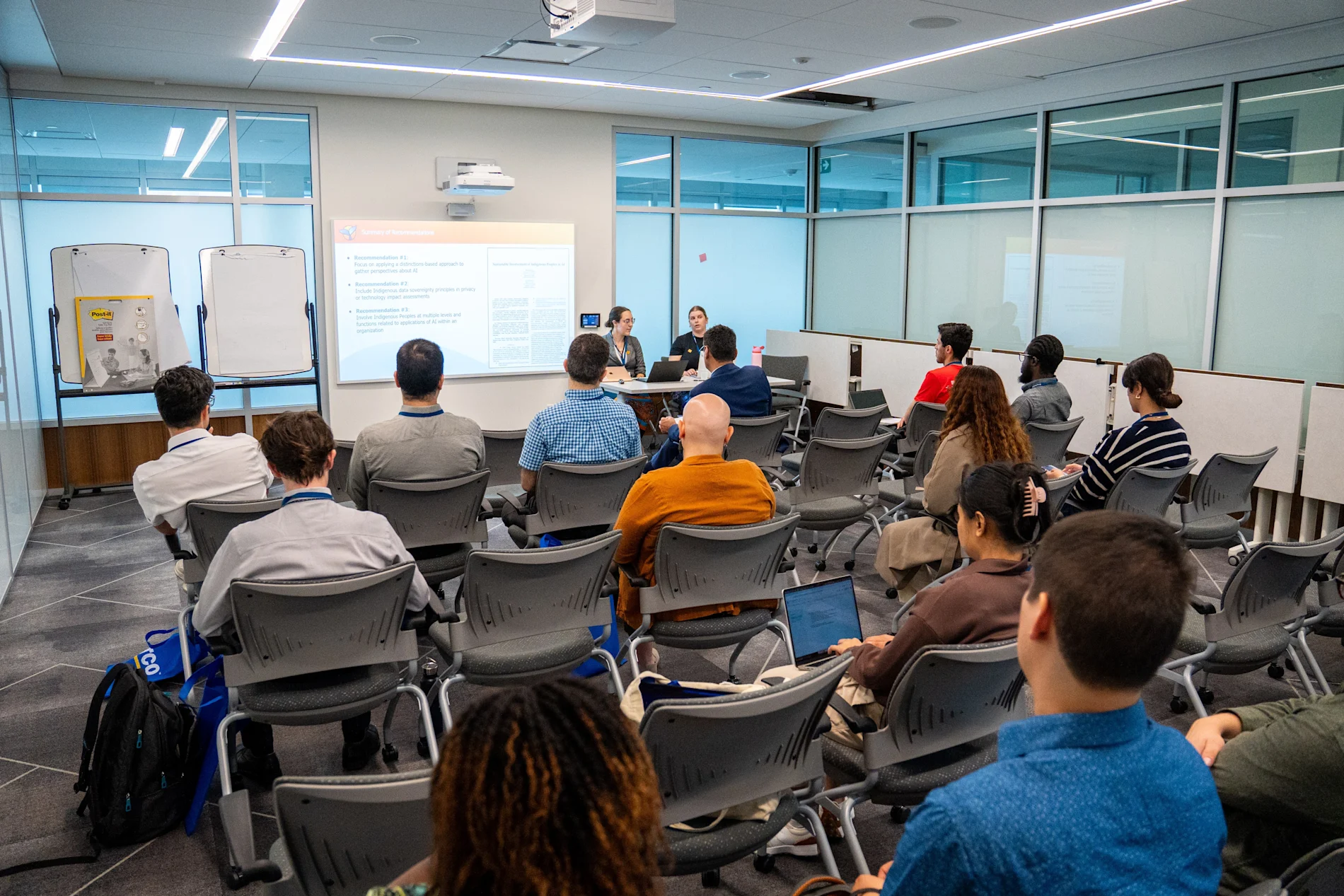
Demers & Burtch presenting at the IEEE
Three key themes of Indigenous involvement in AI
The workshops highlighted three interconnected themes that guide how organizations should approach artificial intelligence and Indigenous communities.
1. Respecting data sovereignty
Indigenous data sovereignty means Indigenous Peoples have the right to govern their own data - how it's collected, stored, used, and shared.
Organizations can respect this right by adopting frameworks like
OCAP®
(Ownership, Control, Access, and Possession) or the CARE
principles (Collective Benefit, Authority to Control, Responsibility, and Ethics). In practice, TELUS has offered OCAP® training for TELUS team members who support data privacy, ethics, governance and AI, and has committed to not using generative AI to replicate Indigenous art or imagery
.2. Involving Indigenous Peoples in AI development
Participants shared that Indigenous communities must be actively involved in the entire lifecycle of AI systems, from its initial design to final governance. Collaboration should focus on key areas like providing AI education for Indigenous communities, offering digital literacy training, and ensuring direct involvement in model development. This collaborative approach produces AI systems with stronger ethical grounding and better outcomes for all users.
For example, TELUS partnering with an Indigenous-owned software testing company
PLATO
to create a specialized "Purple Team
" - a combined red team (offensive testing) and blue team (defensive testing) approach - not only tests AI for bias toward Indigenous Peoples but also strengthens Indigenous expertise and self-determination in AI development. 3. Taking a distinctions-based approach
The workshops revealed that AI development must reflect the distinct cultures, governance structures, and worldviews of First Nations, Inuit, and Métis Peoples. It is essential to recognize the distinctiveness of these groups and avoid generalization. Current AI systems are often built on Western frameworks, which risks failing to represent distinct Indigenous perspectives and perpetuating systemic biases.
TELUS engaged pipikwan pêhtâkwan, an Indigenous-led technology company, to better understand Indigenous ethics as it applies to TELUS' use of large language models and generative AI tools. pipikwan pêhtâkwan advised TELUS by sharing insights about their AI tool wâsikan kisewâtisiwin, which has been guided by Indigenous Peoples across Canada and a diverse Elder Council. The tool can be integrated with existing AI systems to correct unconscious bias and racism toward Indigenous Peoples, and provides a distinctions-based approach by recognizing the unique needs of different communities and offering multiple ways of knowing.
TELUS engaged
pipikwan pêhtâkwan
, an Indigenous-led technology company, to better understand Indigenous ethics in AI as it applies to TELUS’ use of large language models and generative AI tools. pipikwan pêhtâkwan advised TELUS by sharing insights about their tool wâsikan kisewâtisiwin
, which has been guided by Indigenous Peoples across Canada and a diverse Elder Council. The tool integrates with existing AI systems to correct unconscious bias and racism toward Indigenous Peoples, and provides a distinctions-based approach by recognizing the unique needs of different communities and offering multiple ways of knowing. This approach addresses the need to develop AI infrastructure with Indigenous perspectives at its core, thereby strengthening TELUS' guardrails against bias and harm.The path forward
When we build technology that incorporates Indigenous perspectives, protects vulnerable communities, and puts people first, we create better systems for all users. The principles of data sovereignty, meaningful involvement, and cultural sensitivity are fundamental to responsible innovation.
Reconciliation is an ongoing, continual journey for TELUS - one that requires a commitment to active listening and genuine relationship-building.
As AI continues to reshape our world, we have an unprecedented opportunity to do things differently. When we involve Indigenous Peoples and view technology through Indigenous lenses, we build AI systems that honour Indigenous Knowledge while creating better, more ethical technology for everyone.
About This Research: This blog post is based on research presented at the 2025 IEEE International Humanitarian Technology Conference, documenting TELUS’ engagement with First Nations, Inuit, and Métis Peoples through workshops facilitated with Two Worlds Consulting and guided by TELUS' Indigenous Advisory Council.
Resources: