Aug 10, 2026
Bridging science and AI for impact: a conversation with Re:Pair Genomics CEO Shiron Lee
Discover how Re:Pair Genomics CEO Shiron Lee uses voice AI and strategic technology investments to streamline operations and scale her biotech startup.

Authored by TELUS Business
When a team of University of Toronto researchers developed a machine learning algorithm to design custom genetic components for gene therapies, they knew they'd hit a major breakthrough. What traditionally required six to twelve months of lab screening could suddenly happen in a single day. Co-founder and CEO Shiron Lee stepped up to bring this research out of the academic lab and into the biotech marketplace.
Today, Re:Pair Genomics is helping to pave the way for safer, more precise gene therapies for rare diseases. As part of the #StandWithOwners program, which champions Canadian business owners with funding, technology and exposure, Lee shares her journey of navigating biotech, leveraging AI for lean operations and staying disciplined.
What insight drove you to start Re:Pair Genomics?
Lee: My lab members developed an algorithm to optimize gene therapies. They approached me to help commercialize it because I had industry experience and could evaluate market demand.
Since they'd built it entirely on their own, we faced a choice to either let it remain an abstract idea or bring it to life. I saw a chance to bridge academia and industry, so we joined an accelerator and incorporated.
“We faced a distinct choice to either let our research remain an abstract idea or take the leap to bring it to life.”
What's an invisible challenge in moving from academia to startups?
Lee: Our hardest early hurdle was taking our software algorithm and proving it works in the real world through physical biology experiments, what the industry calls "wet lab" testing, without having our own specialized lab space or massive capital. Life sciences founders have got to prepare mentally for how labour and capital intensive biotech really is.
Building trust relies entirely on generating rigorous data to prove your tech works. We're not building a software app to sell overnight. We're transforming how life sciences R&D operates.
What tech decision mattered most to your early survival?
Lee: Applying for grants and pitch competitions takes enormous time. We made a strategic decision to bring AI into our daily routines to handle the heavy lifting of drafting and reviewing applications.
It acts as an extra set of hands, allowing our lean team to submit far more applications and seize opportunities we otherwise would've passed up.
How does AI on your Samsung technology support your day-to-day work, both in the office and inside the lab?
Lee: On the office side, AI acts as a digital assistant for our lean team, scouting global events, checking grant eligibility and handling tasks like proofreading and presentation assets.
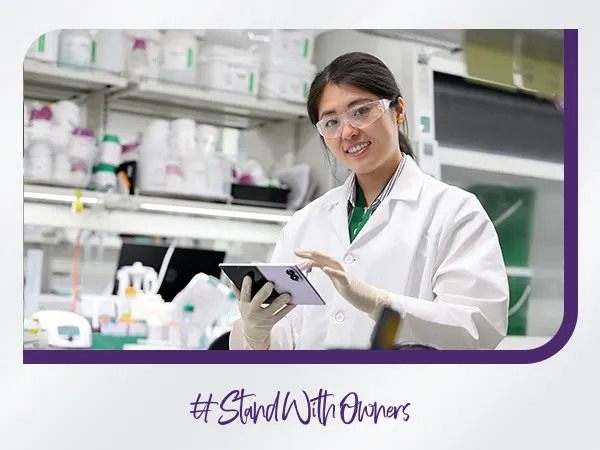
When I step into the lab, that connectivity continues on my smartphone. Wearing lab gloves while handling biological samples creates a contamination risk and makes touchscreens impractical. Using voice-controlled AI on my Samsung phone allows me to dictate notes, check experiment schedules and respond to urgent messages completely hands-free. Having that connected technology means I can manage operations without stepping away from the bench or interrupting critical scientific work.
“Voice control is crucial in the lab. When wearing gloves, hands-free tech keeps us moving without interrupting our work.”
What do you believe is the true value of AI for small businesses?
Lee: AI is only as good as its training data. At Re:Pair Genomics, we use AI to design gene therapy components, but we rigorously validate those designs with partners. Accuracy is just as critical as speed.
Our algorithm minimizes timelines and human error, though our scientists always verify the work before wet lab experiments start. Small business owners should evaluate their operational process, with versus without AI, before fully integrating it.
The #StandWithOwners program recognizes businesses that leverage technology to innovate. What is your best advice for early-stage owners trying to build a strong business case and tech foundation?
Lee: Many small businesses patch their digital setups together out of immediate necessity, but my best advice is to focus on what you can realistically achieve within your actual budget. Instead of chasing every new trend or over-implementing AI, double down on what you do best.
Ask yourself if integrating this new tool is absolutely essential to reaching our next milestone. If not, don’t waste limited capital on technology that won't deliver a clear return on investment. Rushing to adopt unvetted platforms just to keep up can expose your business and customers data to security risks. Protecting your operations starts with being disciplined about the tools you choose to bring into your ecosystem.
What big vision keeps your team energized?
Lee: We want the life sciences industry to be more transparent about sharing data. Sharing both failed and successful experiments prevents wasted time and capital, helping bring cures to patients faster.
Scientists stay in biotech because we know we've got the power to develop life-saving treatments. Knowing you have that ability and not giving it everything you've got would be the biggest regret.
“Knowing you have the power to develop life-saving treatments and not giving it everything you've got would be your biggest regret.”
Your business, boosted.
Re:Pair Genomics shows how combining science, smart technology and a strong network can help change healthcare. Through #StandWithOwners, TELUS Business champions Canadian entrepreneurs with the funding, technology and exposure needed to scale. Apply for funding, tech packages and national recognition. Apply to #StandWithOwners today to get your business boosted.
*Visit website for full contest details.