Aug 20, 2026
Local greens, global thinking: a conversation with AquaVerti Farms owner Georges Aczam
Discover how AquaVerti Farms founder Georges Aczam uses data discipline and customer-first thinking to scale controlled environment farming in Canada.

Authored by TELUS Business
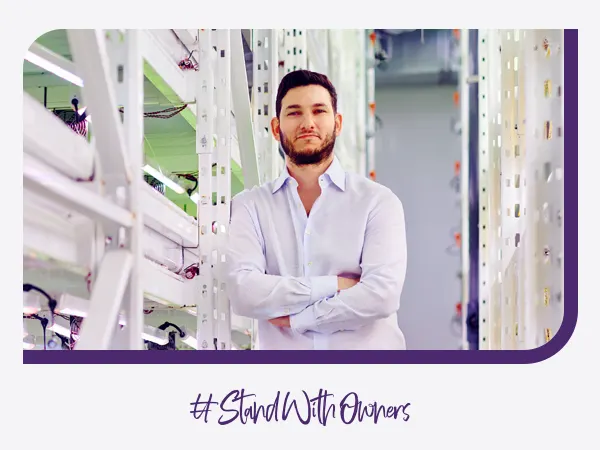
The journey from a seed in the ground to the greens on a dinner table is often thousands of kilometres long but Georges Aczam is narrowing that gap to a matter of city blocks. As the founder of Montréal-based AquaVerti Farms, Aczam recognized that Quebec’s food security was tethered to fragile international supply chains and aging logistics. By merging the province’s clean hydro energy with a sophisticated indoor growing model, he has built a resilient system that delivers crisp and local produce every day of the year regardless of the sub-zero temperatures outside.
As a past #StandWithOwners contest winner, Aczam has proved that controlled environment agriculture is not just a technological feat but a vital pillar for Canada’s self-sufficiency. In this interview, he discusses the evolution of the industry and why the most important ingredient in his greenhouse is not just water or light but the discipline of data.
What drew you to sustainable food production when there were easier paths to take?
Aczam: It started with a very clear gap in the market. As a consumer, I noticed how dependent we were on external supply chains for fresh produce and during the winter our greens lacked both freshness and consistency. With access to clean hydro energy and the ability to grow year-round, I saw an opportunity to build a resilient model that could reduce that dependency on imports. Launching AquaVerti was about offering a superior and local product that did not rely on a border crossing, geopolitical uncertainty or currency fluctuations.
How does the shift toward scalable sustainability shape your business approach?
Aczam: Sustainability has to work within real economic constraints to be viable and we have engineered the business around that reality. For example, for our expansion project, we chose to go with a semi-closed greenhouse. We partnered to use recycled industrial heat which allows us to operate through Quebec winters without relying on natural gas. By focusing on operational efficiency, we can deliver a product that is fresher and more competitive year round.
“We have combined clean energy with automation to reduce labour dependency and improve food safety. No human will be touching the plants, and our production will be carbon emissions free thanks to the heat loop. ”
What is the "invisible challenge" in your sector that almost stopped you?
Aczam: The lack of reliable data was a major hurdle. We were building in a capital-intensive environment where every variable like climate and inputs and cycles directly impacts margins. Early on, very little actionable data existed. As the market shifted toward demanding immediate profitability, we had to become incredibly disciplined. We shifted our mindset from exploration to precision and focused only on the variables that directly moved the needle on our unit economics.
What was the one decision that mattered most to your ability to scale?
Aczam: Bringing in the right partners to help us structure and leverage our data was the turning point. Working with partners like AWS allowed us to turn raw production data into actionable insights and improve our yields while identifying inefficiencies much faster than we could have on our own.
“Moving from operating on assumptions to operating on data fundamentally changed our trajectory and gave us the confidence to scale.”
If you were speaking to a fellow owner entering this space today, what is the first step you would tell them to take?
Aczam: Start with the customer rather than the system. Too many operators fall in love with the technology before they have proven the demand. You need to understand exactly what your customer wants to buy and at what price point. The biggest lesson I have learned is that this business is won or lost on execution.
How has the #StandWithOwners recognition validated your vision?
Aczam: The recognition brought visibility and credibility at a critical time. As food security became a central topic in Canada, being selected for the #StandWithOwners program reinforced that what we were building had social and environmental and economic relevance. It opened doors and validated that our commitment to a local and sustainable food system was the right direction for the future.
Your business, boosted.
AquaVerti Farms is proof that when you align technology with a clear community need, you can change the way an entire region approaches food safety. At TELUS, we believe that small businesses deserve to be celebrated and recognized for the pivotal role they play in making the future friendly for all Canadians.
*Visit website for complete contest details.